
پاکسازی و حذف کامل ویروس هپاتیت ب از بدن و سرم خون توسط داروی جدید دکتر آکرا

درباره سایت
آخرین مطالب
- قابل توجه همکاران گرامی
- داروی جدید arc520 همواره در راه است ... مژده به بیماران عزیز
- بررسی پگ اینترفرون روی منفی کردن hbsag طی سه سال درمان
- قابل توجه همکاران گرامی :
- If hbsag lower than 100 IU/ML
- بررسی پگ اینترفرون روی منفی کردن hbsag طی سه سال درمان
- با سلام و احترام خدمت همه عزیزان
- HD-03/ES: A Herbal Medicine Inhibits Hepatitis B Surface Antigen
- گیاه پر سیاوشان و خواص درمانی آن
امکانات وب
Arrowhead said in a press release the FDA verbally notified the company of its decision to hold the trial until Arrowhead responds to conces raised about deaths in non-human primates given the highest dose in an ongoing nonclinical toxicology study using EX1, an intravenously administered delivery vehicle used in the company’s ARC-520, ARC-521, and ARC-AAT programs.
The doses in this study are higher than those used clinically in humans and are higher than used in previous animal toxicology studies, Arrowhead said.
The FDA has not indicated to Arrowhead that the clinical hold was based on any human data.
So far, EX1 has been administered more than 800 times in more than 300 humans with only three serious adverse events (SAE). Two of the events were fevers, and the third was a case of hepatic carcinoma considered not related to the treatment.
To date, 6 percent of infusions in ARC-520 studies have resulted in clinical reactions, with four patients discontinuing treatment. According to the company, across the ARC-520, ARC-521, and ARC-AAT clinical programs, laboratory tests have not shown any drug-induced organ toxicity.
Arrowhead has already reported data from the animal study t
برچسب:
نویسنده: بردیا نوروزی
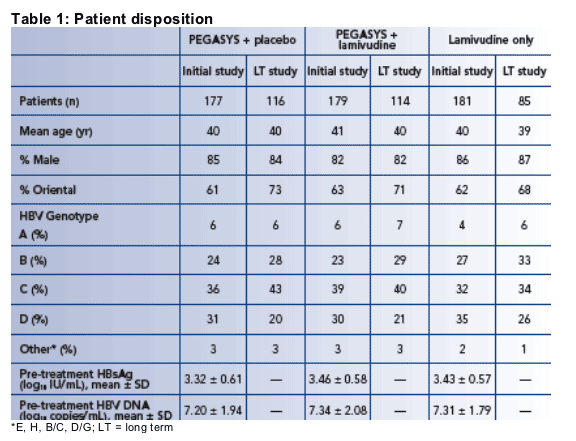 Reported by Jules Levin
AASLD, Nov 2-6, 2007, Boston, MA
P. Marcellin1, M. Brunetto2, F. Bonino3, G.K.K. Lau4, P. Farci5, C. Yurdaydin6, T. Piratvisuth7, K. Luo8, Y. Wang9, S. Hadziyais10, E. Wolf11, M. Popescu12 1Hôpital Beaujon, University of Paris, Clichy, France. 2UO Gastreonterologia ed Epatologia, Azienda Ospedaliera Universitaria Pisana, Pisa, Italy. 3Scientific Direction, Foundation IRCCS Policlinico of Milan and University of Pisa, Italy. 4Department of Medicine, Queen Mary Hospital, Hong Kong, China. 5Dipartimento di Scienze Mediche, Università di Cagliari, Monserrato, Italy. 6Department of Gastroenterology, University of Ankara, Turkey. 7Department of Inteal Medicine, Songklanagarind Hospital, Prince of Songkla University, Hat Yai, Thailand. 8Department of Infectious Diseases, Nanfang Hospital, Guangzhou, China. 9Infectious Disease Department, Xinan Hospital, Chongqing, China. 10Department of Medicine and Hepatology, Henry Dunant Hospital, Athens, Greece. 11MUC Research GmbH, Munich, Germany. 12Roche, Basel, Switzerland.
INTRODUCTION
HBsAg seroconversion (loss of serum HBsAg and development of anti-HBs antibodies) is the hallmark of successful immunological contr
Reported by Jules Levin
AASLD, Nov 2-6, 2007, Boston, MA
P. Marcellin1, M. Brunetto2, F. Bonino3, G.K.K. Lau4, P. Farci5, C. Yurdaydin6, T. Piratvisuth7, K. Luo8, Y. Wang9, S. Hadziyais10, E. Wolf11, M. Popescu12 1Hôpital Beaujon, University of Paris, Clichy, France. 2UO Gastreonterologia ed Epatologia, Azienda Ospedaliera Universitaria Pisana, Pisa, Italy. 3Scientific Direction, Foundation IRCCS Policlinico of Milan and University of Pisa, Italy. 4Department of Medicine, Queen Mary Hospital, Hong Kong, China. 5Dipartimento di Scienze Mediche, Università di Cagliari, Monserrato, Italy. 6Department of Gastroenterology, University of Ankara, Turkey. 7Department of Inteal Medicine, Songklanagarind Hospital, Prince of Songkla University, Hat Yai, Thailand. 8Department of Infectious Diseases, Nanfang Hospital, Guangzhou, China. 9Infectious Disease Department, Xinan Hospital, Chongqing, China. 10Department of Medicine and Hepatology, Henry Dunant Hospital, Athens, Greece. 11MUC Research GmbH, Munich, Germany. 12Roche, Basel, Switzerland.
INTRODUCTION
HBsAg seroconversion (loss of serum HBsAg and development of anti-HBs antibodies) is the hallmark of successful immunological contr
برچسب:
نویسنده: بردیا نوروزی
Abstract
Background.u2003We studied whether quantification of serum HBsAg and HBV DNA levels could predict spontaneous HBsAg clearance in patients with negative hepatitis B e antigen (HBeAg).
Methods.u2003Serum HBsAg and HBV DNA levels were measured at baseline among a longitudinal cohort of 103 HBeAg-negative patients recruited since 1997.
Results.u2003Twelve (12%) patients developed HBsAg seroclearance after 88 ± 26 months (range, 21–139) of follow-up. At baseline, the serum HBsAg level among patients who cleared HBsAg (1.30 ± 1.27 log IU/mL) was significantly lower than those who did not clear HBsAg (2.96 ± 0.84 log IU/mL; P < .001). The area under receiver operating characteristics (ROC) curve for serum HBsAg to predict HBsAg seroclearance was 0.90 (95% confidence interval [CI], 0.83–0.97; P < .001). Nine (75%) of 12 patients who had HBsAg seroclearance versus 8 (9%) of 91 who remained HBsAg-positive had serum HBsAg ≤100 IU/mL at the baseline (P < .001). An HBsAg cutoff of ≤100 IU/mL had 75% sensitivity and 91% specificity to predict HBsAg seroclearance. Baseline serum HBV DNA could not predict HBsAg seroclearance; the area under ROC curve was 0.64 (95% CI, 0.46–0.81; P = .13).
C
برچسب:
نویسنده: بردیا نوروزی